Ad Agency PR Is Never More in Demand than During a Crisis

Palm tree in Puerto Rico

A couple weeks ago, a car crashed into the church I attend. That’s right, a car. And it did some major damage to the area it hit. (The car didn’t come out of this all that well either.)

It happened late at night when the driver, who apparently was traveling at a high rate of speed, missed the curve in front of our church and plowed into the building. He fled on foot, but it didn’t take long for the police to track him down.

I have to admit that I never thought about the possibility of a car hitting our church—but it did. The incident was a stark reminder that a crisis can strike at any time, without warning.

Ad agency PR is never  more in demand—and needed—than in a crisis. A case in point is another incident that took place—also at night—that not only was unexpected, but potentially devastating to a mental health center owed by an agency client.

Somewhere around 3:30 a.m., on a Friday, I got a call from one of the agency’s partners where I worked at the time saying that the client’s mental health center in San Juan, Puerto Rico, had just experienced a fire that damaged a unit of the facility.

Two patients were dead, and reporters were onsite covering the story.

Rumors were flying, I was told, and I needed to get on a plane in the morning to go handle the matter. My weekend was going to a little different than I planned.

When I arrived in San Juan and entered the hotel lobby, my eyes were drawn to a newspaper with a front-page story and photo about a prison riot where 26 people were injured and several guards had been taken hostage. The news media left the mental health center to cover the prison riot, which bought us some time to get organized.

I quickly discovered that the number of newspapers in San Juan numbers in the teens, making it feel more like a regional than local story given the number of print outlets we had to deal with (not to mention radio and TV).

After being transported from my hotel to the mental health center, it didn’t take long for me to realize that the marketing director and chief medical officer (who served as our spokesman) were top-notch pros, and they were going to make my job much easier.

Plus, the center had established good relationships in the community, so it had plenty of goodwill to draw upon, and there was no shortage of people who were willing to help us.

After a quick briefing to ascertain the facts, determine what had been communicated by the media (including rumors that the facility had burned to the ground) and making a list of all our audiences, we developed a game plan, followed by a crash media training session in which I helped our spokesman and marketing director prepare for interviews.

Here’s what happened next:

  • We established a link with the police and fire department spokespersons to get advance notice of what they would say to the media so that we had time to prepare our responses.
  • I worked with the staff to put together a brief statement for employees, patient family members and the news media, updating them on the latest information. The statement expressed concern for the victims’ families and appreciation for the heroic efforts of the staff who tried to save everyone, and managed to do so except, unfortunately, for the two patients who perished. (I later learned these patients were suspected of having set the fire in the first place).
  • The statement included a clear but low-key message that the hospital was functioning, and that only one unit of it was affected by the fire.
  • We also developed a fact sheet explaining what happened to combat rampant rumors and made it available to reporters and other interested parties.
  • Media coverage of our statement was light because of the Columbus Day holiday (which I learned is a big deal in Puerto Rico), so we took out full-page ads reprinting it in leading newspapers.
  • We also sent a letter from our spokesperson, who was highly respected in the local medical community, to key referral sources to ensure they understood that the center was functioning.
  • Finally, we encouraged health care professionals in the community to speak out on behalf of the center within their areas of influence.

All this took place over the weekend, and in less than 48 hours I was able to return home.

In the days that followed, the mental health center reported very positive responses from the community, while the news media was on to its next story.

My main takeaway from this experience: We were able to manage this crisis so effectively in large part because of competent staff and positive relationships in the community.

photo credit: Ricymar Photography (Thanks to all the fans!!!!) via photopin cc

Do Reporters Really Hate PR Pros?

Love hate text

There’s always been a certain amount of tension between reporters and public relations professionals, even though there’s a symbiotic relationship between the two.

Reporters need credible sources and a constant stream of story ideas, while PR people need the news media to help them share important information and spread the word about their clients or employers.

PR people want coverage as favorable as possible, while good reporters want a balanced story that presents all sides and perspectives. PR people want to help shape and influence the story, while reporters bristle when they feel they are being pushed or manipulated.

While there are more PR options available than ever thanks to social media, the news media still are very important because of their reach and perceived credibility.

Anyone who is going to be successful in PR needs to be able to work successfully with reporters, so when I came across an article titled “Why do reporters hate PR pros so much?” I was intrigued.

The headline says “reporters,” which implies all reporters feel this way. And not only do reporters hate PR pros, but they hate them “so much.” That seems like a stretch to me.

It’s been quite a while since I was a reporter, but I can honestly say that I never hated PR people who contact me to share a story idea, even those who were on the annoying side. (In fairness I should mention that I wasn’t a reporter for all that long, so my attitude may have changed had I been on the receiving end of pitches year after year.)

Using several Tweets from disgruntled reporters attacking PR people to support her contention, the writer of this article asks, “Why would anyone hate to hear from someone that is trying to help them professionally?”

And therein lies an important clue as to the cynicism some reporters have toward the PR profession.

As a reporter, I never once thought that someone was trying to help me professionally by pitching a story to me. Nor was my motivation to help a reporter advance professionally by suggesting a particular topic to him or her when I flipped over to the PR side.

My motivation was self-serving:  I was seeking publicity for another party, usually one with which I had a financial interest.

If I did my homework, I knew I was approaching a reporter who covered a particular industry and subject matter to ensure that my pitch was relevant. Ideally, this resulted in a win-win situation for all concerned: A good story for the reporter and a happy client, which in turn made me happy.

The notion that reporters should want to hear from us because we want to help them professionally is about as believable as “I’m with the government and am here to help you.”

The writer goes on to conjecture that “There is something fundamentally wrong with the way PR pros relate to the media.”

That’s undoubtedly true in some cases, but there also are quite a few PR professionals who work very successfully with the media because they understand how reporters think and operate. They take the time to learn what the reporter covers, the preferred methods of contact, when the reporter is on deadline and the types of stories that interest him or her before reaching out.

One of the writer’s suggestions to remedy a PR industry that is “clearly broken,” as she put it, is to send e-mails to reporters that are not pitches but rather “how are you?” inquiries. Considering how much e-mail most reporters get, I suspect that last suggestion is more likely to irritate them, unless you know the reporter very well.

I’m not convinced that the PR industry is broken, nor am I persuaded that we can draw sweeping conclusions from a few negative tweets.

My advice to anyone who wants to be successful in working with the news media is to:

  • Put yourself in the shoes of the reporter you want to reach, and ask yourself how you would like to be approached with a story idea.
  • Get to the point, don’t waste their time and offer them something that is genuinely news or feature worthy within the niche(s) they cover.
  • Understand the details of what you’re pitching, and be prepared to give a succinct explanation as to why it’s worth their time.
  • Take into consideration the timing of your pitch. Old news or a subject that’s been covered from every conceivable angle is not likely to generate much enthusiasm.
  • Avoid taking rejection personally. Look for other opportunities and at all costs avoid being a pest.

Just as having good content is critical to content-marketing success, having a good story idea that is well targeted and properly presented is critical to success in the public relations business.

photo credit: Skley via photopin cc

What Every Ad Agency New Business Director Should Know about PR


I Love PR button

While there are many things that go into a successful ad agency new business program, one that is often overlooked or underutilized is the strategic use of public relations.

Whether your agency emphasizes outbound or inbound marketing – or a combination of the two – PR is an important tool that can help you attract attention and generate new business opportunities.

Here are six things that every ad agency new businesses director should know about PR and how it can give them a competitive edge:

First, as I have noted in previous posts, articles and interviews, PR gives your agency credibility in a way no other medium can because it allows an objective secondary source – a reporter or blogger – to tell your story for you.

Of course agencies provide background information, messaging and insights to help shape such stories, but people tend to give more weight to a news article or a post from a credible blog than from advertising or personal sales.

Second, PR is effective in building widespread awareness, which is particularly useful in getting in front of decision makers who may be difficult to reach through other means.

  • In the past PR shined brightest in generating coverage with TV, radio and print media, but today the Internet can spread the word exponentially.

Third, for inbound marketing initiatives, PR makes you easier to be discovered by prospective clients doing research to identify agencies with your area of expertise.

Fourth, PR can play a vital role in new business development through content creation and management. Many people in public relations have backgrounds with print or broadcast media. Former reporters tend to be good story tellers, which is essential for good content marketing.

  • They know how to consistently provide useful, well-targeted information that is enjoyable to read, builds trust, engages customers and enhances the brand – without coming across as disguised advertisements.

Fifth, with a creative PR writer driving your agency’s content marketing, agencies of any size can compete. To be effective, the content must be relevant, credible and enjoyable to read. It also must be search engine optimized and updated regularly to maximize its potential for attracting new business.

  • It’s easy to talk about producing high-quality, engaging content, but it’s another thing to actually do so on a consistent basis. Agencies that have the discipline to be consistent will reap rewards for their diligence.

Sixth, PR pros are generally the best suited to handle social media engagement. Public relations by definition involves dealing with the public, and PR specialists know the importance of responding to inquiries or complaints accurately, efficiently and tactfully.

  •  Because good public relations focuses on two-way communication with audiences, they understand how to converse with diverse groups or individuals, talking with them rather than at them. And because they often work with reporters who are on deadline, PR people have a keen appreciation for the value of responding in a timely manner.

Social media allows us to start or participate in conversations with individuals we might otherwise not reach. We can answer questions, solve problems, have constructive debates and gain a better understanding of issues and concerns from the other person’s perspective.

To sum it up, PR can give your ad agency’s new business initiatives unparalleled ways of gaining awareness and credibility; enable your agency to communicate directly and indirectly with prospects and influencers; and assist in building your brand and reputation in the marketplace.

photo credit: Cloudberry Communications via photopin cc

What I Learned from My Biggest PR Flop

  Swimmer doing a belly flop

Recently a client asked me to describe my biggest professional failure. (Glad he didn’t ask about my biggest personal failure, as it would have taken me a while to sort through that list.)

I was tempted to borrow Hank Dye’s response when he was asked the same question in a new business presentation. At the time Hank was president of Dye, Van Mol & Lawrence, a leading PR firm in the Southeast and the agency that brought me to Nashville.

Without missing a beat he said, “There weren’t any that the clients knew about.”

Hank understood the importance of serving clients with excellence, and when mistakes happened – as they inevitably do – he was quick to get them corrected.

One of the things that impressed me when I interviewed at DV&L was the agency’s written commitment: “We will do what is right, even if it hurts us.”

Those weren’t just words, we lived by them. (Hank, but the way, was a great mentor to me in many ways, and I will be forever grateful for all that I leaned from him and the other partners.)

Unfortunately, some failures do get noticed by clients. At the top of my list is an event I was responsible for managing that involved the launch of a client’s new product.

At the time I headed up the public relations department for an advertising agency. Everything for the event was planned in great detail. We had several well-known national speakers lined up, along with the company’s CEO and other top executives. I had hired a videographer through a national paid news service to do a video news release (VNR) to help us extend our broadcast coverage, and my team and I had done a full-court press to turn out the news media. We had an excellent press kit and media advisory, and we felt very good about the launch.

In the early morning hours the day of the event, several tornadoes ripped through Middle Tennessee, including downtown Nashville where our event was being held. Guess where all the news media were the morning of our launch? Out covering the damage. We had one TV crew show up briefly for our event, but for the most part it was a publicity flop.

The client understood that there’s nothing much we could do under the circumstances, but it still was very disappointing. We put together a post-event news release with photos, and distributed them through a paid release distribution service as well as through our media list, along with the VNR. We picked up some good national coverage that way, but not as much as we could have gotten under normal conditions.

If we are wise, we learn more from our PR failures than from our successes. One of the lessons I learned from this failure was to always be prepared for the unexpected. Rather than assuming that everything is going to go as scheduled, I now assume something outside of my control will go wrong. I ask more “what if” questions and have a carefully thought through contingency plan.

Of course this event is not the only PR venture that didn’t go as well as I planned, but it’s the one that stands out most in mind my – and the event for which I’d most like to have a redo.

 photo credit: dps via photopin cc

Never Deny the Obvious

One of my all-time favorite apologies came from the CEO of a company who, after reading a long list of grievances recited by an offended customer, started his letter with, “Clearly, we screwed up.”

No excuses. No whining. No defensiveness. Just a clear acknowledgment that the company made a mistake, with the letter apologizing for it and taking corrective action.

The apology was made directly to the offended party who, as I recall, shared it with others and eventually the mea culpa made its way onto a list of excellent apology letters.

I have certainly made my share of mistakes, and when I make one I try to go directly to the offended individual(s) to apologize and ask forgiveness. I’ve had occasion to do this as recently as a few days ago.

  • We can’t control whether people will believe us or forgive us, but we can and should acknowledge our mistake with the offended party. It’s the right thing to do.

Organizations that make mistakes and are quick to apologize will find that most people are quick to forgive. Of course the apology must be sincere to really be effective. If you’ve made a mistake, though, you should want to do what you can to make things right with the offended individual(s) as soon as possible.

Digging in and refusing to acknowledge a mistake generally makes matters much worse, and an insincere apology is usually pretty easy to detect and counterproductive.

  • One of my early career mentors once gave me this sage advice: “Never deny the obvious.”

It’s amazing, though, how many companies and individuals do that very thing. If it’s obvious that you, your agency or client has made a mistake, acknowledge it, take responsibility, ask forgiveness and then move on.


Press Release Is a Key Tool for Ad Agency PR


How Social Are Your Press Releases Image medium_6330943490Is the traditional press release dead, and if so how will its demise affect ad agency PR?

Recently I posed the “Is-the-press-release-dead” question to students in my strategic communications class at Williamson College. I asked them to read an article titled “The end of the press release?” — which makes this claim — and let me know their thoughts about it.

The author, Gregory Galant, concludes his article with this interesting statement: “It’s time we accept that the days of the press release are over-let’s skip the anger, bargaining, and depression stages-and focus on more effective methods for releasing news.”

What exactly those “more effective methods” are Mr. Galant doesn’t spell out, though he notes that “The SEC has even announced that information can be released via social media, provided investors know where to look and it’s not restricted.”

So why does this have to be an either/or situation? Why not use social media to extend the reach of a press release rather than replace it?

I wasn’t convinced the press release is dead, and it turns out my students didn’t buy it, either. One of them commented:

“There are plenty of people in the general public who still do not have Twitter, Facebook, Instagram, Tumblr accounts…There are other who simply don’t get that interested in social media.  There will always be ‘that kind’ of public. They need other ways to find out what’s going on. Newspapers, TV news, etc., are great sources for people who either don’t use social media or who simply want to unplug from the hectic pace of pointless selfies that fill the Internet.  Sometimes I like hearing about important information through social media, but usually I treat that as entertainment…There have to be lots of folks out there like me.  Press releases are not dead.”

Good insights from someone who is smack dab in the middle of the generation that grew up with social media.

Mr. Galant cites four reasons the days of press releases are “long gone.” I’ll summarize and respond to each one.

1. Today, seconds after you post a press release on the Internet, it’s no longer new news.

True, but so what? How is using social media or other methods going to change that?

2. Google itself has said that it’s discounting content that you pay to distribute and has explicitly warned against putting unnatural links in press releases.

Who says everybody pays to distribute their press releases? Having updated media lists are vital for any PR person. Paid services should supplement, not totally replace, an in-house media list. And if you are going to be held hostage to Google’s constantly changing search algorithm, you’ll likely end up at the algorithm funny farm.

3. People must want to share your content with their friends and followers. A formal announcement typically isn’t well suited to these channels.

Companies make announcements through “formal” press releases all the time. If the topic is of interest, why wouldn’t people want to share it regardless of how the content is delivered?

4. The SEC has already provided the guidance that public companies can simply post announcements on their websites, rather than use a press release service.

Okay, so public companies have options – how does that prove the traditional press release is dead? As I noted earlier, why not use a press release and social media to extend your reach and let people choose how they prefer to receive information?

My student had it right. Press releases are not dead – and they’re not likely to die out anytime soon.

photo credit: PRNewswireGlobal via photopin cc

8 News Release Mistakes to Avoid for Ad Agency PR Success


Image of laptopWhat’s the number one problem reporters have with public relations?

In a survey of more than 1,700 journalists and editors sponsored by Bulldog Reporter and Cision, 60% of them cited their biggest beef as the lack of relevance of the materials they received from corporate communications and PR professionals. Much of this information, they noted, is written like advertising, not journalism.

That’s a sure-fired way to have your news release or press kit trashed.

Ad agencies that want to be taken seriously by reporters should avoid these eight mistakes when writing a news release:

1. The “no news” news release. This is where you’re trying to get your agency or client some media coverage but without a real news hook. It’s better to hold off on your release until you have an appropriate angle to justify contacting a reporter. If you want some ideas on creative publicity topics, check out my “Ad Agencies Top 20 Topics for Publicity” post.

2. Puffery and exaggerated descriptions of people, events, products or services – followed by lots of exclamation marks!!!!!! Nothing screams amateur quite like that.

3. Platitudes and vague generalities.

4. Verbosity. It’s usually harder to write short, concise copy than long copy, but journalism is all about being succinct and to the point.

5. Stating things that are subjective and opinion-based as facts. If you want to include a statement that involves an opinion or judgment, turn it into a quote and attribute the statement to someone.

6. Writing about “pseudo” events that are contrived to get attention but have no real news value.

7. Consistently leading with the name of your boss in the headline or first paragraph.

8. Writing like an advertising copywriter instead of a journalist. (See journalists’ top concern above.) To be considered credible by the news media, you have to write your news release as objectively as possible, emphasizing its news value, connection to a trend or its human interest aspect. Use third-person pronouns and the active rather than passive voice.

photo credit: timsnell via photopin cc

Podcast: How Ad Agencies Can Use PR to Grow Their Business


Don Beehler interview with Jason SwenkIn my interview with Jason Swenk on The Smart Agency Masterclass, I explain how ad agencies can use public relations to get more coverage, gain credibility and enhance their awareness in the marketplace. I also discuss some of the biggest mistakes ad agencies make with their PR efforts and free resources they can utilize for publicity opportunities. You can hear my interview with Jason here.


Five Tactics for Using PR to Take Your Ad Agency to the Next Level

Ladder going to clouds

Last week during a podcast interview with Digital-Preneur Jason Swenk, I was asked to give some actionable advice to digital, creative and marketing agency owners who want to use public relations to take their agencies to the next level. Great question. Here are five suggestions to help your agency achieve that objective:

1. Develop a written PR plan to compliment new business initiatives.

A written plan will help you manage your time, resources and activities in the most effective way possible. YOU WANT TARGETED, CONSISTENT COVERAGE – and a plan will serve as a road map to get your agency where you want it to go.

As you develop your plan ask yourself, and anyone else involved in the planning process, some important questions:

  • What are the desired results from our PR?
  • Do we primarily need to create awareness or change perceptions of our agency?
  • Do we want PR to help position us as experts in our existing niche or to enter a new industry and become experts there?
  • Who are our key audiences?
  • What are the best communications vehicles to reach them?
  • What are our points of differentiation and key messages?
  • How will the PR plan complement our new business development initiatives?

2. Learn all you can about the news media you are targeting.

The best way to increase your chances for success with your publicity efforts is to understand what the news media want, how they work, their pet peeves and what constitutes a good story – from their perspective. It’s also important to know their audience and what will appeal to them.

Most reporters use social media such as Twitter and have blogs, so you can follow them, learn about their interests and even make comments when appropriate to get on their radar.

The key to publicity success is getting the right story idea to the right reporter at the right time.

3. Identify ways to become a source for reporters and influential bloggers.

This is the quickest route to credibility and achieving the perception of expert status in the eyes of your target audience. If during an interview you prove to be responsive, knowledgeable, trust worthy – and you communicate well – the chances are good that reporters and bloggers will come back to you again for future stories.

4. Utilize your blog to create online buzz and establish your expertise.

Blogs are a great way to build your reputation as a subject matter expert (SME) in a particular niche. Followers look to SME’s to express opinions and insights on things happening in that niche, identify trends and provide perspective. Focus on good, relevant, original content and avoid blatant self-promotion. And don’t be afraid to take a stand counter to conventional wisdom!

5. Write a book.

A book can be used to generate publicity (and therefore increase visibility) about an individual and his/her agency, as well as open doors to speaking opportunities. But it does much more because writing a book enables you to share value lessons and insights about your niche, and it enhances your status a subject matter expert. A book can also help you market your agency.

You may already have a good start on your book through content from blogs, newsletters, industry articles, etc. Or, once your book is published, you can repurpose material from it in the same venues such as your blog.

Niche books are the new calling cards for many agencies, and being a published author can really give you a competitive edge. Think how impressive it would be to leave a signed copy of your book at the conclusion of each new business presentation.

photo credit: FutUndBeidl via photopin cc

Here’s a Way for Newspapers to Remain Relevant

Like many parts of the country we are holding local elections in our community, and campaigns are in full swing. I have some issues with one of our candidates and tried submitting a letter to the editor about his record to both our local papers.

In both cases, they informed me they are not running letters related to the election due to the high volume of mail they receive about candidates and their limited editorial space.

One of the papers also expressed concern about not being able to give candidates equal time when there are multiple elections being held in nearby counties.

Stop and think about that for a minute: A high volume of letters indicates this is something people want to discuss. They want to engage in an exchange of information and points of view, but the papers are saying they can’t accommodate their readers’ desires. 

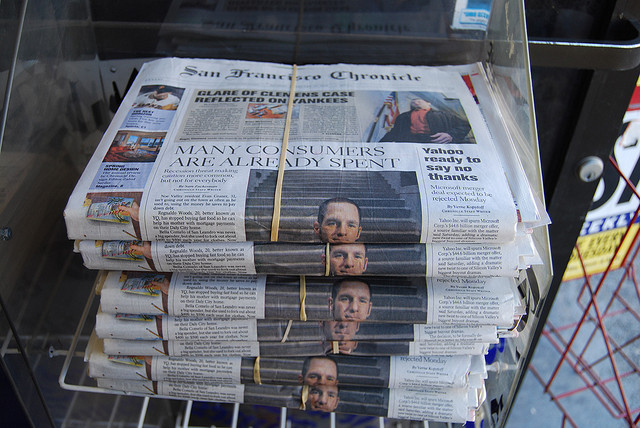
Bundle of newspapers

While I certainly can appreciate the reality of limited space, could we look at this from the readers’ perspective for a minute? Shouldn’t local papers’ editorial pages take the lead in providing a forum for the community to discuss issues and hold elected officials accountable for their records?

And isn’t it almost always the case that papers get more letters to the editor submitted on a topic than they can run? To make a blanket policy of not publishing any letters related to an election is really pretty amazing and short-sighted to me.

Coverage of local issues – and what readers think about them – is one of the most important services a newspaper can provide.

It’s no secret that Internet news sites, blogs, Facebook, Twitter, online chats, etc., have had an adverse effect on newspapers across the country. When a paper declines to provide a forum to exchange ideas and information for something as important as an election, people turn to social media and other venues to get the word out or get answers to their questions.

Which, over time, can make newspapers less relevant and perpetuate the cycle of declining readership.

So here’s my idea for providing a place for voters to get information about candidates prior to elections, ask questions and discuss important issues, without taking up valuable editorial space and without the editorial staff having to worry about treating candidates equally:

Create a special online site several months prior to an election, perhaps on the paper’s website itself, where people can submit letters and generate discussion.

For elections in which there are hundreds of candidates for office across multiple counties, the paper could have a separate page for each country, and people could post questions to the appropriate candidates, giving the candidates an opportunity to respond.

That would generate some genuine interaction and give equal opportunity to all concerned.

I suspect a lot of people would utilize a site like that to get the scoop because most information comes from standard candidate profiles in local papers, direct mail and radio ads from the candidates themselves, or from talking with friends.

It’s really challenging to uncover much of substance, and most people don’t have the time to do a lot of research on their own.

The papers could promote these sites through their print editions – as an extension of the papers themselves – and they might even be able to sell banner ads on them.

From a marketing standpoint, with a site like that a local paper would be utilizing new media in an innovative way that adds value to its readers’ experience and helps it stay relevant in a highly competitive world where there is an increasing number of news and information alternatives for consumers.

photo credit: Steve Rhodes via photopin cc