Ad Agencies: Here’s a Way to Strengthen Relationships with Reporters Who Cover Your Clients

Media looking at car at Nissan facility

One of my most memorable experiences was the time I spent in Guatemala on a mission trip, where I was part of a team that helped build a school for kids living in extreme poverty. The school was going up next to the church that was spearheading its construction, and today there are about 700 students who attend. They are receiving an education that is much more than a competitive edge; it is a ticket that will help them escape poverty.

I had been to other parts of the world and seen some poor places, but nothing I experienced was quite like this. The church complex was built on a hill that overlooked a valley, and as far as I could see in any direction there were shacks built of cinder block, corrugated tin, pieces of plywood—and whatever else the residents could cobble together for a dwelling. The houses lacked running water and had dirt floors. No one knew for sure how many people lived in this valley, but the government estimated the population to be in the hundreds of thousands.

The majority of people who attended the church came from this valley. They were some of the warmest, most loving, friendly and joyful individuals I’d ever met. During the weekdays when we were engaged in construction, a number of mothers were working with us, using shovels, picks or even their bare hands to help out. They knew what this school would mean to their children, and they were determined to do their part to build it. I also got to spend some time in the valley visiting a child my family and I were sponsoring.

You can see pictures of poverty, but there’s no substitute for experiencing it in person and getting to know real people, by name, who are trapped in it. My time there certainly gave me a new perspective on the blessing we enjoy in America, and I look forward to returning to Guatemala someday, hopefully in the not-too-distant future.

Vision trips for news media and major donors have been used very successful by some of the world’s largest nonprofit ministries and humanitarian relief organizations precisely because such visits help them see the work being done first hand. They enable those who go to experience a situation personally in a way that words and images simply cannot convey adequately. Such trips also are great for getting news media and donors acquainted with people in areas affected by disasters, extreme poverty, etc.

While onsite trips to less exciting places, such as manufacturing plants, have much less emotional impact, they still can be used very effectively by ad agencies to build or solidify relationships with reporters who cover a particular industry.

Bringing a small group of journalists to a client’s facility for a day or overnight trip gives them an opportunity to meet top management; get briefed on new developments, plans and trends; and see for themselves the client’s operations in action. They should also have plenty of opportunities to ask questions and engage in discussion with management.

Here are two examples of such media trips that I was involved with personally. The first was an agency client that was a global supplier of hot-metal machines and solutions. You might be surprised at how many trade journalists there were at the time covering the adhesives industry, so we had a good pool of prospects from which to draw. Bringing news media onsite was a first for this company, and it resulted in about half a dozen very positive industry-specific stories running in the months that followed the trip.

The second example is when Saturn introduced its cars in Japan. Saturn invited several top Japanese auto journalists to Spring Hill, Tennessee, to test out its vehicles in a day-long ride-and drive event. And believe me, they did a thorough job of testing them, including seeing how well they could handle fast-paced curves in the Middle Tennessee countryside. (It’s also where I saw a memorable sign in a small-town grocery store we passed through that proudly proclaimed: “We sell Kroger ice cream.”)

The Japanese journalists got to meet with Saturn senior management and engineers; tour the plant; attend a briefing with short presentations about what’s going on with the company; and participate in group Q&As and even one-on-one meetings, if desired.

Both of these events generated post-event coverage, but even if media trips don’t produce immediate results, they are still important because they strengthen relationships with reporters who cover your client’s industry, giving them in-person access to senior management and the opportunity to be onsite. The dividends from such trips will unfold over time.

photo credit: chuckoutrearseats via photopin cc

Norwegian Cruise Line Sinks Image in PR Fiasco

Image of lego ship

I’m not sure why this is the case, but it seems like cruise lines run aground more often than most industries when it comes to PR fiascos.

As I noted in a 2012 post titled Cruise Ship Flunks Crisis Management 101, the luxury cruise ship Costa Concordia (owned by Carnival), didn’t appear to have much of a crisis plan when it got stuck off the coast of Italy. In 2013, a Carnival ship was stuck at sea for nearly a week. (This and other Carnival incidents are described in Business Insider.)

The latest PR challenge is Norwegian Cruise Line’s refusal to reschedule a family’s vacation after Nicolas, the 5-year-old son, was diagnosed with cancer. Because of surgery and chemo treatment, the family was unable to go on the trip as scheduled.

Norwegian, which partnered with Nickelodeon for this family-orientated cruise, would not re-book the cruise because the family cancelled the trip within 14 days or less of the departure date. And, because the family hadn’t purchased travel insurance, it was out $4,000 – a lot of money for most people – while also suffering through the trauma of battling their son’s cancer.

“It’s just unbelievable that a multimillion dollar company wouldn’t be more compassionate,” the mother told a Long Island TV station.

This is one of those common sense things that is really hard to process. Who at Norwegian made this decision, and what were they thinking?

If Norwegian’s management team was so cold and heartless that they didn’t care about this family’s extraordinary circumstances, were they also completely blind to the PR disaster that was sure to follow?

Predictably, social media began to spread the word. A Facebook page was set up imploring Norwegian Cruise Line to “Please Help Little Nicolas.”

Yesterday, feeling the heat of public outrage (and probably sensing a multi-million dollar problem unfolding before their eyes), Norwegian posted a Facebook message saying that the company had “offered to work with the family when Nicolas was ready to travel to ensure that they took their vacation and we provided a personal contact at Norwegian for the family. . . .”

Does that mean Norwegian will comp the trip or will the family have to come up with another $4,000? Or maybe they’ll discount the trip? It’s not clear what the company is offering.

The Facebook message went on to say, “We contacted the Make-A-Wish Foundation, an organization that we work closely with to grant the wishes of hundreds of children each year who want to take a cruise. If the family chooses to participate in the Make-A-Wish program, we will make sure that they receive the cruise they were looking forward to.”

So now the family has to go through Make-A-Wish to get their trip. Hmmm.

I don’t know which advertising and/or PR agency Norwegian uses (or if all that work is done in-house), but surely some outside adviser must have said, “Hey wait, refusing to re-book this family’s trip due to your inflexible cancellation policy is not a good idea. Even if you don’t really care about them, you need to act like you care or you’ll face a huge PR backlash.”

Unfortunately, advertising and public relations agencies can only advise their clients; they can’t make them do anything, and there are times when management makes decisions that prove to be very costly to a company’s image in the long run for short-term gain.

In this case, sticking to a rigid cancellation policy and pocketing $4,000 from the family will likely cost Norwegian exponentially more in the months and years to come.

There is a happy ending to the story, though, at least for this family. After hearing about the family’s plight on “Fox & Friends,” the CEO of another cruise line contacted them and offered a free cruise.

Even more impressive, the CEO reportedly requested to remain anonymous.

photo credit: pasukaru76 via photopin cc

Framing the Right Message for the Right Audience

Picture of a brown wooden frame

Creating targeted messages that are relevant and persuasive enough to motivate recipients to take action is worth the effort, because the way a message is framed (how it is put into context or presented) can make all the difference in the world in how that message is received.

The theory is that how something is presented (“the frame”) influences choices people make. For example, “day care” may equate to babysitting in the minds of many people, but “early education” has a much more positive connotation, according to a case study cited in Strategic Communications for Nonprofits:

“…research found that the most powerful frames on this issue linked pre-K to school readiness and better performance in the early grades—a focus on the educational needs of children, not the babysitting needs of their parents.”

Assuming you’ve done your homework so that your messaging is based on solid research rather than a hunch – and that you understand where your target audience is in its thinking, values and beliefs – it’s time to begin carefully choosing words to craft a targeted, attention-getting message.

Using the right words to send the right message to the right audience, through the right communications vehicle at the right time, are all keys to successful messaging.

 photo credit: Filter Forge via photopin cc

Press Release Is a Key Tool for Ad Agency PR


How Social Are Your Press Releases Image medium_6330943490Is the traditional press release dead, and if so how will its demise affect ad agency PR?

Recently I posed the “Is-the-press-release-dead” question to students in my strategic communications class at Williamson College. I asked them to read an article titled “The end of the press release?” — which makes this claim — and let me know their thoughts about it.

The author, Gregory Galant, concludes his article with this interesting statement: “It’s time we accept that the days of the press release are over-let’s skip the anger, bargaining, and depression stages-and focus on more effective methods for releasing news.”

What exactly those “more effective methods” are Mr. Galant doesn’t spell out, though he notes that “The SEC has even announced that information can be released via social media, provided investors know where to look and it’s not restricted.”

So why does this have to be an either/or situation? Why not use social media to extend the reach of a press release rather than replace it?

I wasn’t convinced the press release is dead, and it turns out my students didn’t buy it, either. One of them commented:

“There are plenty of people in the general public who still do not have Twitter, Facebook, Instagram, Tumblr accounts…There are other who simply don’t get that interested in social media.  There will always be ‘that kind’ of public. They need other ways to find out what’s going on. Newspapers, TV news, etc., are great sources for people who either don’t use social media or who simply want to unplug from the hectic pace of pointless selfies that fill the Internet.  Sometimes I like hearing about important information through social media, but usually I treat that as entertainment…There have to be lots of folks out there like me.  Press releases are not dead.”

Good insights from someone who is smack dab in the middle of the generation that grew up with social media.

Mr. Galant cites four reasons the days of press releases are “long gone.” I’ll summarize and respond to each one.

1. Today, seconds after you post a press release on the Internet, it’s no longer new news.

True, but so what? How is using social media or other methods going to change that?

2. Google itself has said that it’s discounting content that you pay to distribute and has explicitly warned against putting unnatural links in press releases.

Who says everybody pays to distribute their press releases? Having updated media lists are vital for any PR person. Paid services should supplement, not totally replace, an in-house media list. And if you are going to be held hostage to Google’s constantly changing search algorithm, you’ll likely end up at the algorithm funny farm.

3. People must want to share your content with their friends and followers. A formal announcement typically isn’t well suited to these channels.

Companies make announcements through “formal” press releases all the time. If the topic is of interest, why wouldn’t people want to share it regardless of how the content is delivered?

4. The SEC has already provided the guidance that public companies can simply post announcements on their websites, rather than use a press release service.

Okay, so public companies have options – how does that prove the traditional press release is dead? As I noted earlier, why not use a press release and social media to extend your reach and let people choose how they prefer to receive information?

My student had it right. Press releases are not dead – and they’re not likely to die out anytime soon.

photo credit: PRNewswireGlobal via photopin cc

8 News Release Mistakes to Avoid for Ad Agency PR Success


Image of laptopWhat’s the number one problem reporters have with public relations?

In a survey of more than 1,700 journalists and editors sponsored by Bulldog Reporter and Cision, 60% of them cited their biggest beef as the lack of relevance of the materials they received from corporate communications and PR professionals. Much of this information, they noted, is written like advertising, not journalism.

That’s a sure-fired way to have your news release or press kit trashed.

Ad agencies that want to be taken seriously by reporters should avoid these eight mistakes when writing a news release:

1. The “no news” news release. This is where you’re trying to get your agency or client some media coverage but without a real news hook. It’s better to hold off on your release until you have an appropriate angle to justify contacting a reporter. If you want some ideas on creative publicity topics, check out my “Ad Agencies Top 20 Topics for Publicity” post.

2. Puffery and exaggerated descriptions of people, events, products or services – followed by lots of exclamation marks!!!!!! Nothing screams amateur quite like that.

3. Platitudes and vague generalities.

4. Verbosity. It’s usually harder to write short, concise copy than long copy, but journalism is all about being succinct and to the point.

5. Stating things that are subjective and opinion-based as facts. If you want to include a statement that involves an opinion or judgment, turn it into a quote and attribute the statement to someone.

6. Writing about “pseudo” events that are contrived to get attention but have no real news value.

7. Consistently leading with the name of your boss in the headline or first paragraph.

8. Writing like an advertising copywriter instead of a journalist. (See journalists’ top concern above.) To be considered credible by the news media, you have to write your news release as objectively as possible, emphasizing its news value, connection to a trend or its human interest aspect. Use third-person pronouns and the active rather than passive voice.

photo credit: timsnell via photopin cc

Podcast: How Ad Agencies Can Use PR to Grow Their Business


Don Beehler interview with Jason SwenkIn my interview with Jason Swenk on The Smart Agency Masterclass, I explain how ad agencies can use public relations to get more coverage, gain credibility and enhance their awareness in the marketplace. I also discuss some of the biggest mistakes ad agencies make with their PR efforts and free resources they can utilize for publicity opportunities. You can hear my interview with Jason here.


Five Tactics for Using PR to Take Your Ad Agency to the Next Level

Ladder going to clouds

Last week during a podcast interview with Digital-Preneur Jason Swenk, I was asked to give some actionable advice to digital, creative and marketing agency owners who want to use public relations to take their agencies to the next level. Great question. Here are five suggestions to help your agency achieve that objective:

1. Develop a written PR plan to compliment new business initiatives.

A written plan will help you manage your time, resources and activities in the most effective way possible. YOU WANT TARGETED, CONSISTENT COVERAGE – and a plan will serve as a road map to get your agency where you want it to go.

As you develop your plan ask yourself, and anyone else involved in the planning process, some important questions:

  • What are the desired results from our PR?
  • Do we primarily need to create awareness or change perceptions of our agency?
  • Do we want PR to help position us as experts in our existing niche or to enter a new industry and become experts there?
  • Who are our key audiences?
  • What are the best communications vehicles to reach them?
  • What are our points of differentiation and key messages?
  • How will the PR plan complement our new business development initiatives?

2. Learn all you can about the news media you are targeting.

The best way to increase your chances for success with your publicity efforts is to understand what the news media want, how they work, their pet peeves and what constitutes a good story – from their perspective. It’s also important to know their audience and what will appeal to them.

Most reporters use social media such as Twitter and have blogs, so you can follow them, learn about their interests and even make comments when appropriate to get on their radar.

The key to publicity success is getting the right story idea to the right reporter at the right time.

3. Identify ways to become a source for reporters and influential bloggers.

This is the quickest route to credibility and achieving the perception of expert status in the eyes of your target audience. If during an interview you prove to be responsive, knowledgeable, trust worthy – and you communicate well – the chances are good that reporters and bloggers will come back to you again for future stories.

4. Utilize your blog to create online buzz and establish your expertise.

Blogs are a great way to build your reputation as a subject matter expert (SME) in a particular niche. Followers look to SME’s to express opinions and insights on things happening in that niche, identify trends and provide perspective. Focus on good, relevant, original content and avoid blatant self-promotion. And don’t be afraid to take a stand counter to conventional wisdom!

5. Write a book.

A book can be used to generate publicity (and therefore increase visibility) about an individual and his/her agency, as well as open doors to speaking opportunities. But it does much more because writing a book enables you to share value lessons and insights about your niche, and it enhances your status a subject matter expert. A book can also help you market your agency.

You may already have a good start on your book through content from blogs, newsletters, industry articles, etc. Or, once your book is published, you can repurpose material from it in the same venues such as your blog.

Niche books are the new calling cards for many agencies, and being a published author can really give you a competitive edge. Think how impressive it would be to leave a signed copy of your book at the conclusion of each new business presentation.

photo credit: FutUndBeidl via photopin cc

Here’s a Way for Newspapers to Remain Relevant

Like many parts of the country we are holding local elections in our community, and campaigns are in full swing. I have some issues with one of our candidates and tried submitting a letter to the editor about his record to both our local papers.

In both cases, they informed me they are not running letters related to the election due to the high volume of mail they receive about candidates and their limited editorial space.

One of the papers also expressed concern about not being able to give candidates equal time when there are multiple elections being held in nearby counties.

Stop and think about that for a minute: A high volume of letters indicates this is something people want to discuss. They want to engage in an exchange of information and points of view, but the papers are saying they can’t accommodate their readers’ desires. 

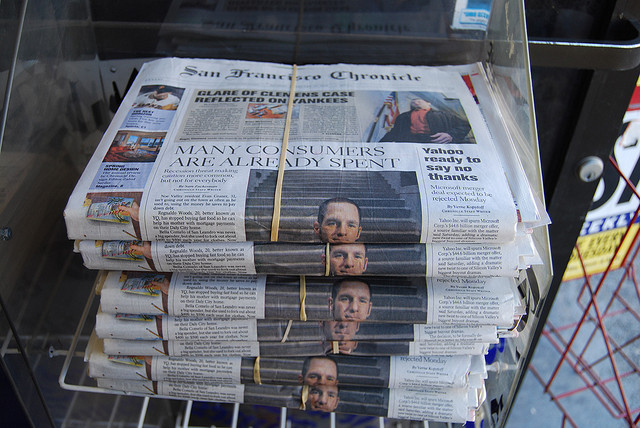
Bundle of newspapers

While I certainly can appreciate the reality of limited space, could we look at this from the readers’ perspective for a minute? Shouldn’t local papers’ editorial pages take the lead in providing a forum for the community to discuss issues and hold elected officials accountable for their records?

And isn’t it almost always the case that papers get more letters to the editor submitted on a topic than they can run? To make a blanket policy of not publishing any letters related to an election is really pretty amazing and short-sighted to me.

Coverage of local issues – and what readers think about them – is one of the most important services a newspaper can provide.

It’s no secret that Internet news sites, blogs, Facebook, Twitter, online chats, etc., have had an adverse effect on newspapers across the country. When a paper declines to provide a forum to exchange ideas and information for something as important as an election, people turn to social media and other venues to get the word out or get answers to their questions.

Which, over time, can make newspapers less relevant and perpetuate the cycle of declining readership.

So here’s my idea for providing a place for voters to get information about candidates prior to elections, ask questions and discuss important issues, without taking up valuable editorial space and without the editorial staff having to worry about treating candidates equally:

Create a special online site several months prior to an election, perhaps on the paper’s website itself, where people can submit letters and generate discussion.

For elections in which there are hundreds of candidates for office across multiple counties, the paper could have a separate page for each country, and people could post questions to the appropriate candidates, giving the candidates an opportunity to respond.

That would generate some genuine interaction and give equal opportunity to all concerned.

I suspect a lot of people would utilize a site like that to get the scoop because most information comes from standard candidate profiles in local papers, direct mail and radio ads from the candidates themselves, or from talking with friends.

It’s really challenging to uncover much of substance, and most people don’t have the time to do a lot of research on their own.

The papers could promote these sites through their print editions – as an extension of the papers themselves – and they might even be able to sell banner ads on them.

From a marketing standpoint, with a site like that a local paper would be utilizing new media in an innovative way that adds value to its readers’ experience and helps it stay relevant in a highly competitive world where there is an increasing number of news and information alternatives for consumers.

photo credit: Steve Rhodes via photopin cc

10 New Business PR Questions that Make Agencies Pause

Last week I passed the 12-year mark with my public relations consulting business. During that period, I’ve been blessed to work with some outstanding clients – more than 70 of them in a wide variety of industries.

Before going out on my own in 2002, I spent a decade with advertising and PR agencies in Chicago and Nashville, where I worked with clients from local to national levels. So, all together, it’s safe to say that I’ve served well over a hundred clients in my career.

After 22 years in the agency business, when someone approaches me to help with a company’s PR needs, I’ve learned to ask a lot of questions up front to make sure I understand what the prospect really is after, whether he/she has realistic expectations, and how success with be determined and measured.

I’ve also identified a number of red-flag questions. Some of those questions (or statements) are covered in this PR Daily article “8 things you should never say to PR agency pros”  by Dorothy Crenshaw, CEO and creative director of Crenshaw Communications.

My two favorites from her list are:

  • How much for a press release?
  • We’re looking at 30 agencies and hope you’ll want to participate.

I decided to create my own list of questions I’ve heard from prospective clients over the course of my agency career that caused me (and sometimes my colleagues) to pause. They weren’t always in these exact words, but here’s the gist of what they were asking:

  1. We don’t have much of a budget – can you help us anyway?
  2. What will it cost us to work with you?
  3. How much publicity can you get us?
  4. How long will it take to get results?
  5. What would it take to get us on (name a national media outlet)?
  6. If we have x dollars to spend on advertising or PR, how much should we spend on PR?
  7. Can you guarantee us we’ll get a certain number of media hits?
  8. Are your fees negotiable?
  9. Can we try you out for 30 days and see how it goes?
  10. Are you willing to tie your compensation to your results?

The short answer to most of these questions is “it depends.” For me, a couple of them are “no” responses, though that can vary from agency to agency.

But the real point is that the questions themselves may indicate a misunderstanding of how public relations works and the costs associated with it.

The most efficient way for a client to work with an agency is to first have clearly thought through what it is they want PR to accomplish for them and how it will integrate strategically into other marketing efforts.

Having a budget established upfront helps a PR professional determine how to get maximum value for the client instead of wasting time trying to guess what that client is willing or able to pay.

And while professional skills and competence are vital, I’m convinced that trust is at the core of any successful client-agency relationship, and that character is every bit as important as sound strategy, outstanding service and dynamic creative.

One of my former agency colleagues used to say it boils down to this when a potential client selects an outside person to help accomplish something: Do I like this person, do I trust this person and can this person get the job done?

Those are three great questions and if you can answer “yes” to all three of them, you’ve likely found a good match.


Cleveland’s “Communicator of the Year” Learns Brutal PR Lesson

Newspaper headline with sobering job statsOn any given day I usually get a number of emails from various PR/communications news and information sources. And truthfully, more times than not, I glance at the subject lines and usually don’t take the time to read them unless something really stands out.

But yesterday, when I ran across this subject line, I had to stop and take a look for myself: “Brutal emails to employment seekers.”

What sort of person would write a brutal email to someone looking for a job, I wondered? Then I was introduced to Kelly Blazek, manager of a Cleveland-area job bank and principle of Gemba Communications, LLC. Oh, and she also was Cleveland’s “2013 IABC Communicator of the Year.”

So now I was even more intrigued – a person who is expected to have good people skills and manners, and a certain level of social media savvy, was replying to some job seekers in what can only be described as rude, demeaning, “How-dare-someone-like-you-contact-someone-like-me” language.

She actually seemed to enjoy belittling people who were seeking help, which is why I think this story resonated so strongly with people when they heard the details.

You can read some of what this little sweetheart from northeast Ohio had to say to folks seeking to network with her or be part of her job bank in this PR Daily article and in Cleveland.com, which as of a few minutes ago had 431 comments, most of which were not very favorable toward her. This afternoon, CNN picked up the story with the headline “Nasty LinkedIn rejection goes viral.” Uh oh.

Apparently Ms. Blazek hadn’t considered the possibility of some on the receiving end of her vitriolic responses taking to social media to expose her nastiness, which is pretty stunning when you think about it.

What communications professional in this day and age isn’t aware that anything one puts in writing to an individual – particularly through a platform like LinkedIn – can be made public via the Internet for the world to see?

Not surprisingly, Ms. Blazek is getting raked over the coals in Cleveland and throughout the PR community.

She apologized for her rudeness – which is all well and good – but really, what else could she do when this blew up in her face? Is she truly sorry for her behavior or just sorry that she got caught? Only she knows, but I found this comment on the Cleveland.com site revealing, if true:

“I know Kelly quite well, and she’s only kind and gracious when it benefits her. To those she deems beneath her, well, she can be quite sadistic. This is Long Time Coming and Just Desserts in my opinion.”

So what lessons can be learned from all this?

For one thing, character really does count and how we relate to others really does matter, regardless of their “level” or what they can “do” for us.  The Gold Rule – treating others as you would like to be treated – is the best policy for personal and professional success.

A second lesson is that apologizing isn’t always some magic bullet to make things better. For sure, this whole sorry matter would have been worse had she not apologized, but the fact that Ms. Blazek went to some lengths to write these demeaning replies to multiple people tells me she enjoyed all this, which really says something about this lady’s psyche. I can’t imagine anyone wanting to do business with her.

But even giving Ms. Blazek the benefit of the doubt that her apology was sincere, what’s most troubling to me is the glee she seemed to take in kicking people who may already be down emotionally.

At one time or another most people have had to look for a job, and it can tough – especially in today’s market. They face a lot rejection. So the last thing someone needs when trying to network with someone running a job bank is to get a demeaning “you’re a worm” response from a person who should be supportive and encouraging of others.

To this day I remember very clearly people who, early in my career, took time to speak with me and helped me network when I was job hunting. And I remember some who wouldn’t give me the time of day, but thankfully I never got the sort of awful treatment this lady dished out.

If people are such a pain to her, she really ought to get out of the communications business.

Third, even if someone you don’t know requests help or an endorsement, be polite in declining the request. Sure there are job hunters who are presumptuous, annoying or clueless, but you never know what a person has been through on a particular day. Some of them might be desperate, and the way you respond to them might make or break them. I’ve been fortunate to have some good mentors, and one thing they taught me was to show dignity and respect to all people.

Fourth, this incident clearly demonstrates how quickly a crisis can develop and then spiral out of control. Once one of her responses went public and was discussed on a local radio show, others who had received similar correspondence began to surface. And I wouldn’t be surprised if more followed.

Will Ms. Blazek be able to recover and resume her communications and job-bank businesses? Time will tell but if I were her, I’d hang on to those job-bank contacts because she may be needing them soon.

photo credit: Sadie Hernandez via photopin cc